
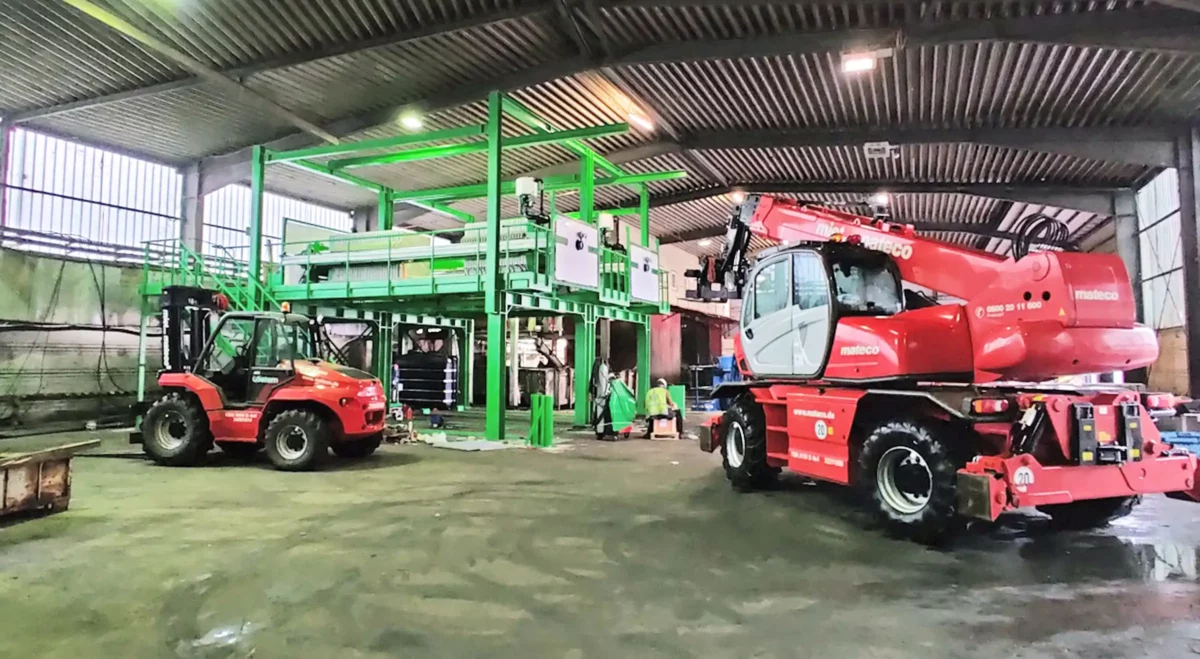
The waste and energy industry has fundamentally changed and with it the demands that operators must meet today. Materials once regarded merely as waste products have become part of complex circular systems. Thermal waste treatment, anaerobic digestion, mechanical-biological treatment, flue gas cleaning, and modern recycling processes now work together with the common goal of generating energy, treating water, recovering valuable materials, and minimizing emissions.
Within these integrated systems, filtration plays a central role. Beyond solid-liquid separation, it directly influences the stability and economic performance of the entire process.
This is precisely how MSE filter press technology is positioned. MSE filter presses are engineered as process solutions for mechanically and chemically demanding media and for operators who require controlled processes, reliable results, and a robust foundation for sustainable material cycles.
Individual system solutions
A Filtration Environment with High Variability
Residual materials generated by Waste-to-Green and Waste-to-Energy processes reflect the diversity of their origins. They result from a wide variety of waste and energy streams and therefore differ significantly in composition:
01
Mineral media, such as fly ash or APC residues
02
Reactive media, including sludge from flue gas cleaning
03
Fibrous organic media, such as digestate or biogas sludge
04
Process-specific materials, including pyrolysis fines
These media are rarely consistent. Particle structures change, pH values fluctuate, and conductivity responds sensitively to changing process conditions.
Standard solutions quickly reach their limits in such environments. What is required are filtration systems that accurately reflect this complexity rather than attempting to simplify it.
The challenge
The Solution Begins with Understanding the Process
The challenges presented by these demanding media cannot be explained by a single parameter. Their complexity only becomes apparent through the interaction of multiple characteristics.
Chemical Reactivity in Flue Gas Cleaning Residues
Chlorides, sulfates, carbonates, and hydroxides from wet and semi-dry flue gas treatment processes remain chemically active. They require construction materials capable of maintaining long-term reliability under continuous operation.
Abrasion Caused by Mineral and Semi-Mineral Particles
Fly ash, bottom ash, boiler ash, and pyrolysis fines behave like abrasive materials that expose and attack every weakness in mechanical components.
Organic-Mineral Hybrid Media from Anaerobic Digestion and Biogas
Digestate exhibits flow behavior ranging from fibrous and highly viscous to abrasive and shear-sensitive. Typically containing 7–10% solids with slightly acidic pH values between 4 and 7, these media combine organic structures with mineral particles and require pressure profiles that preserve rather than destroy their structure.
Daily Variations in Material Streams
Today, Waste-to-Green facilities may process activated carbon residues; tomorrow, biogas fibers; and the next day, finely dispersed mineral components. Filtration must not only compensate for these changes but actively control them through flexible process engineering.
The Need for High Filtrate Quality in Closed Water Circuits
In systems where water is continuously recirculated rather than consumed, filtrate quality directly influences downstream processes, including energy consumption, chemical usage, and overall process stability.
The solution
MSE Understands Filtration as an Integrated Process System
MSE filter press technology represents a holistic engineering concept in which technical precision is embedded in every detail. The objective is to provide process-engineered solutions for complex material streams.
Mechanical Integrity for Abrasive and Reactive Media
The frame construction withstands continuous abrasive loading, while the filter plate geometry resists concentrated mechanical stresses. All product-contact components are selected to ensure long-term resistance against chemically reactive media.
Filtrate Quality as a Central Process Objective
Clean filtrate stabilizes flue gas treatment systems, reduces chemical consumption, and ensures reliable water recirculation. Consistent filtration prevents the overall process from becoming unstable.
Automation for Continuous Plant Operation
Waste-to-Energy and Waste-to-Green facilities rarely stop operating. MSE filter presses therefore offer automation concepts specifically designed for 24/7 production from automatic plate opening to remote process diagnostics.


For reliable results
Applications That Require This Level of Precision
The application range of MSE filter press technology is as diverse as the industrial processes in which it operates every day. Wherever complex material streams must be controlled reliably, MSE provides dependable filtration performance.
Typical applications include:
- Residues from flue gas cleaning
- Fly ash, bottom ash, and APC residues
- Pyrolysis and thermolysis residues
- Activated carbon and adsorbent suspensions
- Industrial wastewater as well as precipitation and clarification sludge
- Fine particles from mechanical-biological waste treatment
- Digestate and biogas sludge
These media place exceptionally high demands on process engineering. Varying particle sizes, fluctuating compositions, and challenging dewatering characteristics make them difficult to predict.
Developing reliable, reproducible, and economically efficient material flow concepts for these processes is a central element of MSE’s engineering philosophy.

Real-time process intelligence
AI:PureLogic – Data-Driven Process Control for Filtration
With AI:PureLogic, MSE’s intelligent control platform, the filter press becomes a fully integrated, data-driven process component within the overall plant.
The system continuously monitors and evaluates critical operating parameters, including filling behavior, sludgeconsistency, filter cloth condition, and deviations in pressure and cycle time.
Based on this information, filtration parameters such as pressure stages, squeezing times, filter cloth cleaning, and automatic filter cake detaching devices are automatically optimized to maintain stable performance despite changing media characteristics.
This adaptive process control delivers measurable operational benefits:
- Reduced energy and chemical consumption
- Less downtime through early detection of process deviations
- More stable and shorter cycle times
- Reduced operator workload through automated adjustments
- Transparent and traceable process data
AI:PureLogic therefore supports consistent, reproducible filtration while simplifying the integration of filtration into continuous industrial operation.
Responsibility, forward thinking, and sustainability
Filtration as an Active Contribution
In Waste-to-Energy and Waste-to-Green facilities, filtration plays a decisive role in both resource efficiency and process safety. It directly influences water quality, overall energy performance, and the recovery of valuable materials.
Within these plants, MSE filter presses function as integrated process components that support stable operation even as technical and regulatory requirements continue to increase.
A comprehensive overview of the technical and environmental aspects of sustainable filtration can be found in the dedicated section:

Experience and expertise
Why Operators of Demanding Waste and Energy Processes Choose MSE
Selecting a filter press for demanding waste and energy applications is rarely based on a single technical feature.
Instead, operators evaluate the interaction between mechanical design, material selection, process engineering, and automation under real operating conditions.
As integrated process solutions, MSE filter presses provide:
- Stable process performance despite changing media compositions and operating conditions
- Precise pressure and process control capable of detecting even the smallest process variations
- Construction materials designed for aggressive, abrasive, and highly demanding media
- High filtrate clarity to protect water circuits and downstream processing
- Sophisticated automation concepts supporting reliable 24/7 operation
- Predictable operating performance that stabilizes OPEX while supporting long-term sustainability goals
Taken as a whole, MSE filter press technology provides a structured process solution that stabilizes plant operation while ensuring predictable economic performance.
Contact
Your Next Step
The MSE engineering team supports plant operators in safely, reproducibly, and sustainably dewatering residues from thermal, biological, and chemical waste treatment processes.
Request your free process analysis today

The MSE Techletter
Find out all about the latest technologies, developments and valuable know-how about filtration technology – with our Techletter!
Inquiry Form
Your Process Requirements at a Glance
The more we know about your process medium and the relevant process parameters, the more accurately we can assess your filtration application. Simply provide the available information and supporting documents. We will review your requirements and get back to you to discuss the next steps and the appropriate technical solution.