

In the Roast-Leach-Electrowinning (RLE) process, filtration performs a central function within the overall hydrometallurgical system. It not only influences the quality of an individual process step but also has a direct impact on the stability of the entire production line. The leaching residue generated after the leaching stage represents a particularly demanding medium: fine-particle, abrasive, chemically active, and exceptionally dense due to its high metal content.
#Reliable process control therefore requires filtration that is not designed as an isolated separation stage but is understood as an integral, process-defining component of the overall system. The objective is to ensure long-term process stability, maximum recovery rates, and consistent plant performance.
Challenges
Complex Residues Require Precise Filtration Concepts
Leaching residues are typically generated at temperatures above 80°C in highly sulfuric acid environments. Their mineralogical composition varies depending on the production site but shows recurring characteristics worldwide: fine jarosite and sulfate phases, iron-rich intermediate products, silicate fines, and poorly soluble reactive minerals.
This combination responds sensitively to pressure profiles, temperature fluctuations, and particle interactions, making filtration one of the most technically demanding stages in zinc hydrometallurgy.
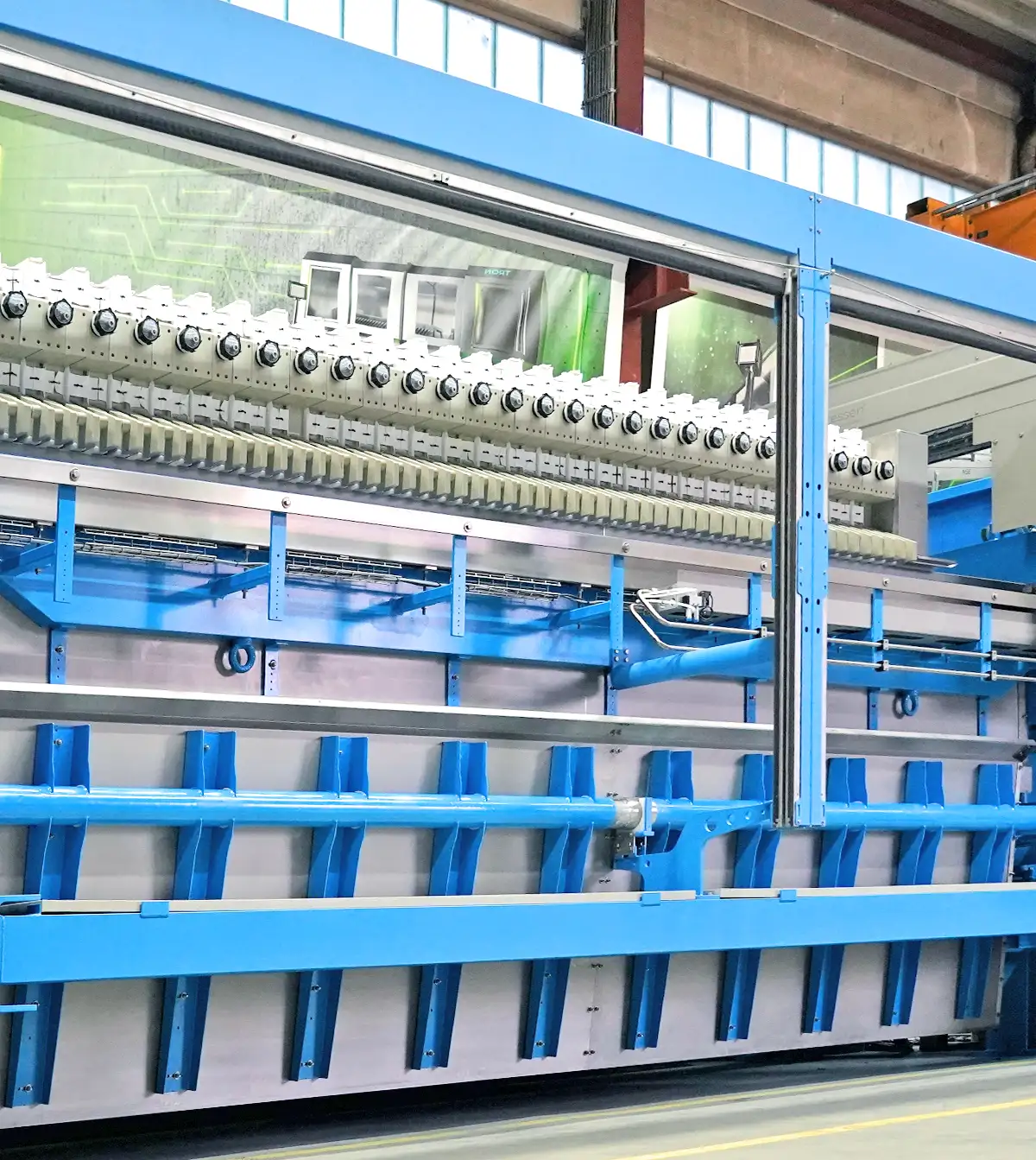
The resulting filter cake is particularly dense and heavy due to its high metal content, placing considerable demands on the mechanical design of the filter press. At the same time, the finest particle fractions compact at an early stage of filtration, meaning that conventional pressure profiles quickly reach their limits.
Consequently, every process stage from feeding and pressure control to filter cake discharge must be precisely managed.
Impact on stability and purity
Filtrate Quality as a Stabilizing Factor Within the Circuit
A significant portion of the filtrate generated during the RLE process is returned directly to the leaching stage. As a result, filtrate quality has an immediate impact on the stability and purity of the entire hydrometallurgical circuit.
Even small amounts of suspended solids can increase contamination levels, promote deposits, and raise cleaning requirements in downstream process stages.
Precisely engineered filtration ensures that process water can be recirculated under stable conditions while maintaining control over both chemical consumption and energy demand.
Practical experience
Typical Challenges in RLE Filtration
Plant operators frequently report recurring challenges during daily operation:
- metal losses in the residue caused by insufficient separation
- fluctuating filtrate quality affecting electrowinning and purification
- irregular filter cake structures that complicate handling, transport, and disposal
Additional challenges include severe chemical and mechanical stresses caused by aggressive process media, which place continuous loads on membranes, filter plates, and sealing systems.
Fine-particle sludge quickly pushes conventional pressure profiles beyond their limits, while continuous 24/7 operation leaves no room for filtration bottlenecks.
Insufficiently controlled filtration can therefore lead to increased chemical consumption, additional work in electrowinning, rising operating costs, unstable cycle times, and ultimately reduced performance throughout the entire process line.
A system designed for complex applications
Filter Press Technology as a Process-Defining Element
MSE filter presses enable operators to manage this complexity systematically, transforming filtration into a stabilizing element within the sensitive RLE process.
01
Thermally and Chemically Resistant Membrane Filter Plates
For media at approximately 85°C and high sulfuric acid concentrations, PVDF-based membrane filter plates are used. They provide outstanding thermal and chemical resistance while ensuring long service life, homogeneous filter cakeformation, and reproducible filtrate quality.
02
Water-Supported Squeezing
Water-squeeze technology enables uniform compaction of dense, metal-rich filter cake. Residual moisture is specifically reduced, improving handling, transportation, and downstream processing.
03
Mechanical Robustness and Material Resistance
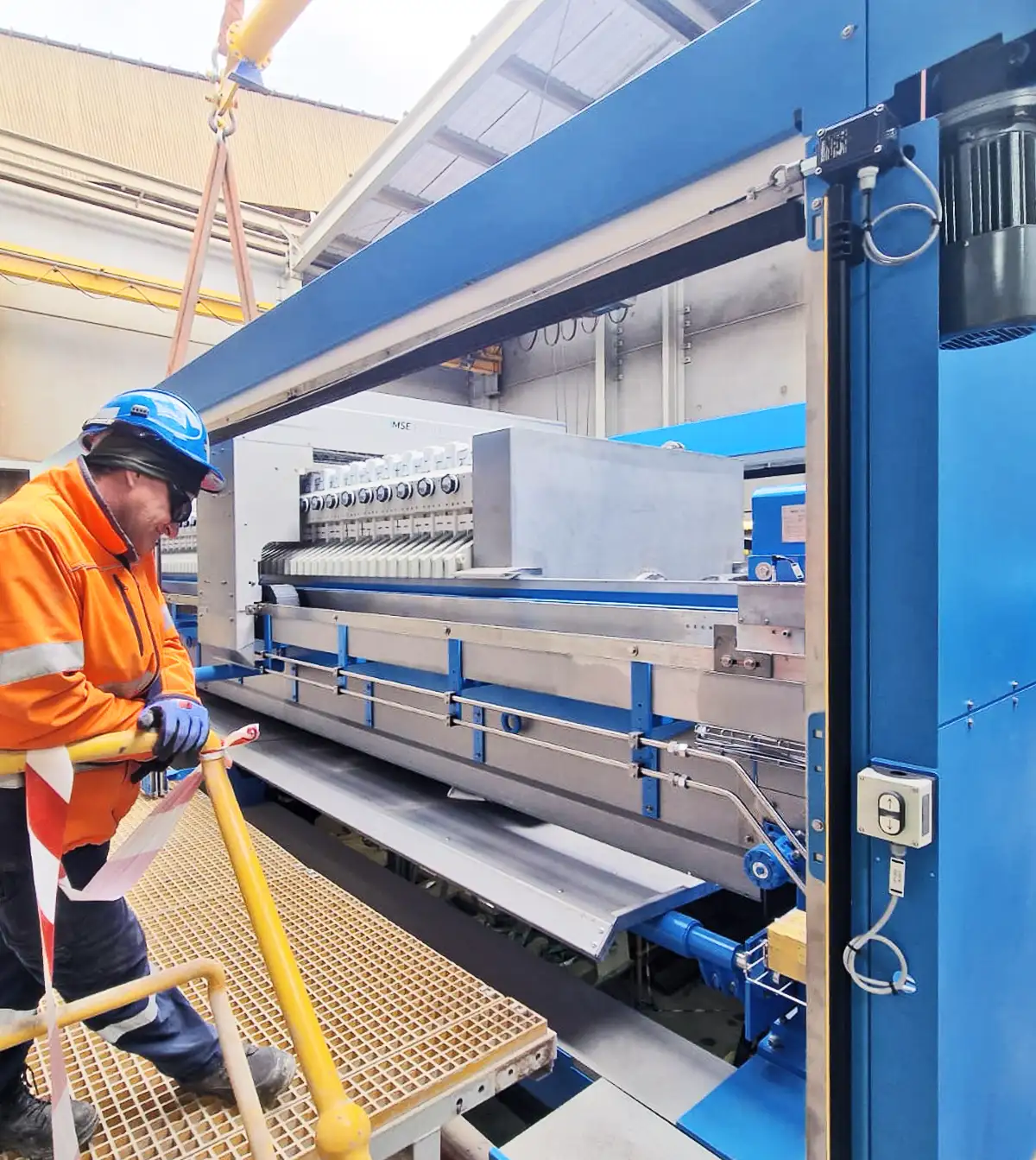
Heavy filter cake, abrasive silicate particles, and aggressive process conditions require carefully engineered system designs. Frames, plate guidance systems, and hydraulics are designed for high loads and continuous cycling. Product-contact components are manufactured from high-alloy stainless steels.
04
Structured Pressure Control Strategy
Processing RLE sludge requires precisely controlled pressure profiles. Progressive pressure development promotes homogeneous, easily discharged filter cake while maintaining stable cycle times.
05
Enclosed System Design
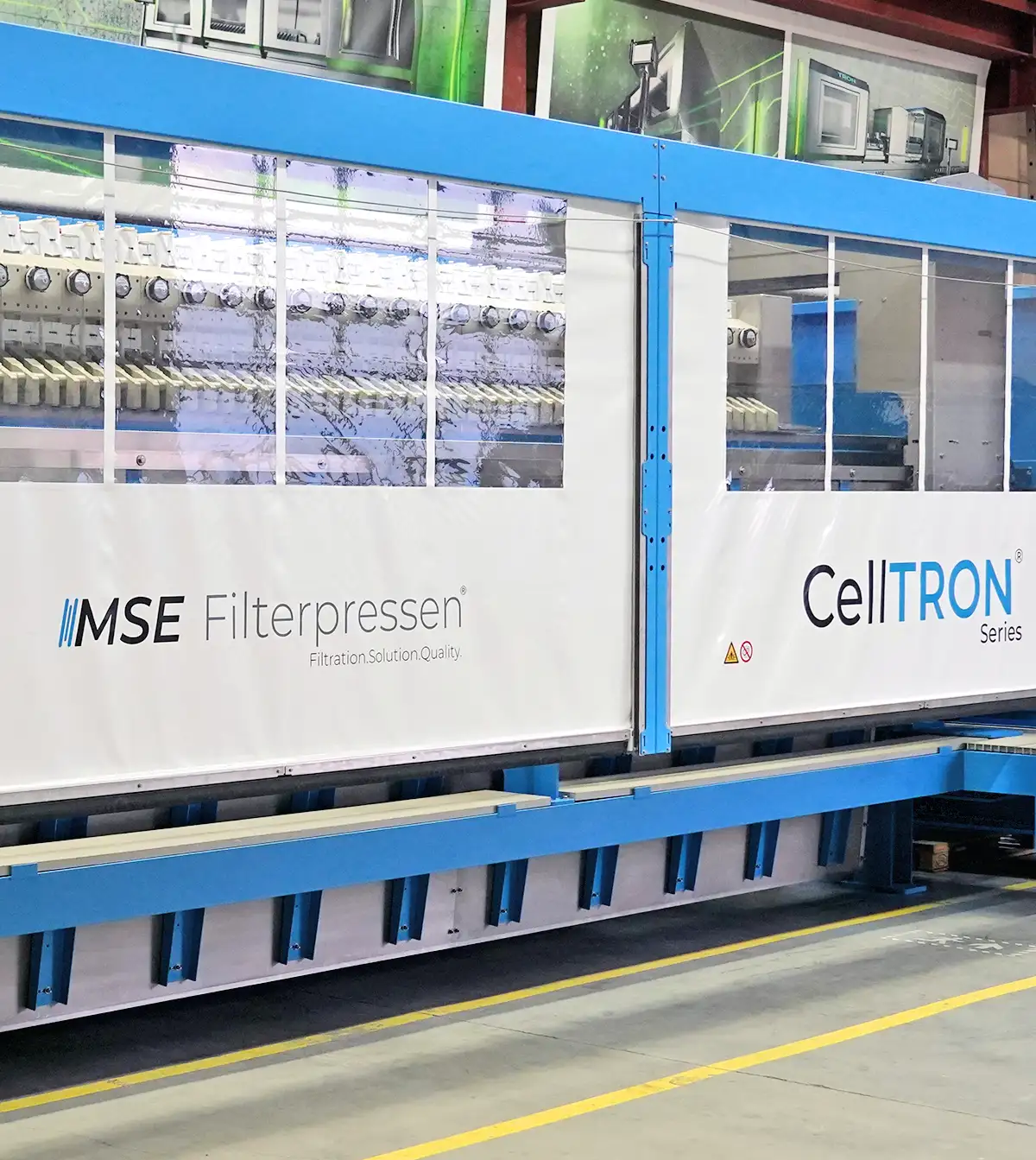
Fully enclosed systems reduce emissions, minimize operator exposure to hot acidic media, and contribute to safe, controlled plant operation.
06
Automation for Continuous Operation
Fully automated concepts are available for RLE applications, including automatic cake post-treatment, automatic cake discharge with weighing cells, automatic filter cloth cleaning, automatic swivel drip trays, and process-specific control logic covering every stage of filtration.
The objective is to ensure that filtration becomes a stable pace-setting process rather than a production bottleneck.
Media variability
Site-Specific Engineering Instead of Standard Solutions
The composition of leaching residue varies considerably depending on ore source, roasting conditions, sulfate balance, and side streams.
For this reason, every residue is treated as an individual process medium.
Pressure profiles, construction materials, operating temperature ranges, washing sequences, and automation levels are all defined specifically for each production site to ensure predictable and stable filtration performance.

Real-time process intelligence
Digital Process Support with AI:PureLogic
Using the AI:PureLogic control platform, the filter press becomes a fully integrated, data-driven component of the overall plant.
Parameters such as filling behavior, sludge consistency, filter cloth condition, and pressure profiles are continuously monitored.
Based on this information, the system automatically adjusts pressing pressure, squeezing times, filter cloth cleaning, and automatic filter cake detaching devices.
The result is reduced downtime, more stable cycle times, transparent process data, and optimized energy and chemical consumption.
Controlled handling
Filtration as a Stabilizing Element Within the RLE Process
Within the RLE process, high temperatures, aggressive chemistry, ultra-fine particles, and exceptionally dense solids combine to create one of the most demanding filtration environments.
Filter press technology must reliably withstand these conditions while consistently delivering reproducible results.
Filtration therefore performs a stabilizing function throughout the hydrometallurgical process.
Clean filtrate supports consistent leaching chemistry, homogeneous filter cake enables controlled handling, and stable cycle times contribute to economically predictable plant operation.
Contact
Your Next Step
Since every RLE process is unique to its production site, the same applies to filtration.
A comprehensive analysis of the leaching residue by the MSE engineering team forms the basis for designing a filter press solution capable of reliably handling high-density media, aggressive chemical environments, and complex particle structures.
Request your free process analysis today
Trade Press
More informations

The MSE Techletter
Find out all about the latest technologies, developments and valuable know-how about filtration technology – with our Techletter!
Inquiry Form
Your Process Requirements at a Glance
The more we know about your process medium and the relevant process parameters, the more accurately we can assess your filtration application. Simply provide the available information and supporting documents. We will review your requirements and get back to you to discuss the next steps and the appropriate technical solution.