

The production of modern catalysts requires precise process control and well-defined material behavior. Oxidic carrier materials, complex intermediates, and fine chemical compound sludge react sensitively to mechanical, thermal, and chemical influences. Filtration directly affects product purity, structural integrity, washing efficiency, and ultimately the quality of downstream processing.
Many of these media consist of particles in the micro- or submicron range. Their highly active surface chemistry responds even to minor variations in pressure or temperature. In this environment, filtration determines not only the efficiency of solid-liquid separation but also the material quality of the final product.
Demanding Media as a Process Engineering Reality
Catalyst production consists of a sequence of synthesis, precipitation, washing, activation, and thermal treatment. Each stage produces media with specific filtration requirements. These include highly dispersed particles, metal-containing or chemically sensitive compounds, as well as carrier structures whose properties may change under pressure.
Such systems tend to compact rapidly, react sensitively to uneven pressure profiles, and require filtrate with a defined ion profile to ensure reproducible washing processes.
Precisely controlled filtration is therefore essential for maintaining a stable and reliable process chain.
Typical Challenges in Fine Chemicals and Catalyst Production
In daily operation, recurring challenges become apparent. Extremely fine particles tend to compact if pressure increases too early. Variations in filtrate quality influence ion profiles, while chemically demanding systems place high requirements on materials and temperature management.
At the same time, every production batch must remain reproducible, since deviations in later process stages can only be corrected to a limited extent.
In this environment, a filter press designed solely for dewatering is not sufficient. What is required is technology that actively supports both product structure and process stability.
Controlled Filtration as the Technical Solution
A carefully controlled pressure profile promotes the formation of homogeneous filter cake structures, improving both dewatering and washing efficiency.
At the same time, the machine architecture provides excellent chemical resistance against acidic, alkaline, and metal-ion-containing media.
An essential aspect of catalyst production is advanced cake post-treatment, including wash pressing. This facilitates filter cake discharge, supports defined residual moisture, and depending on the medium improves washing efficiency and structural uniformity without placing excessive mechanical stress on the material.
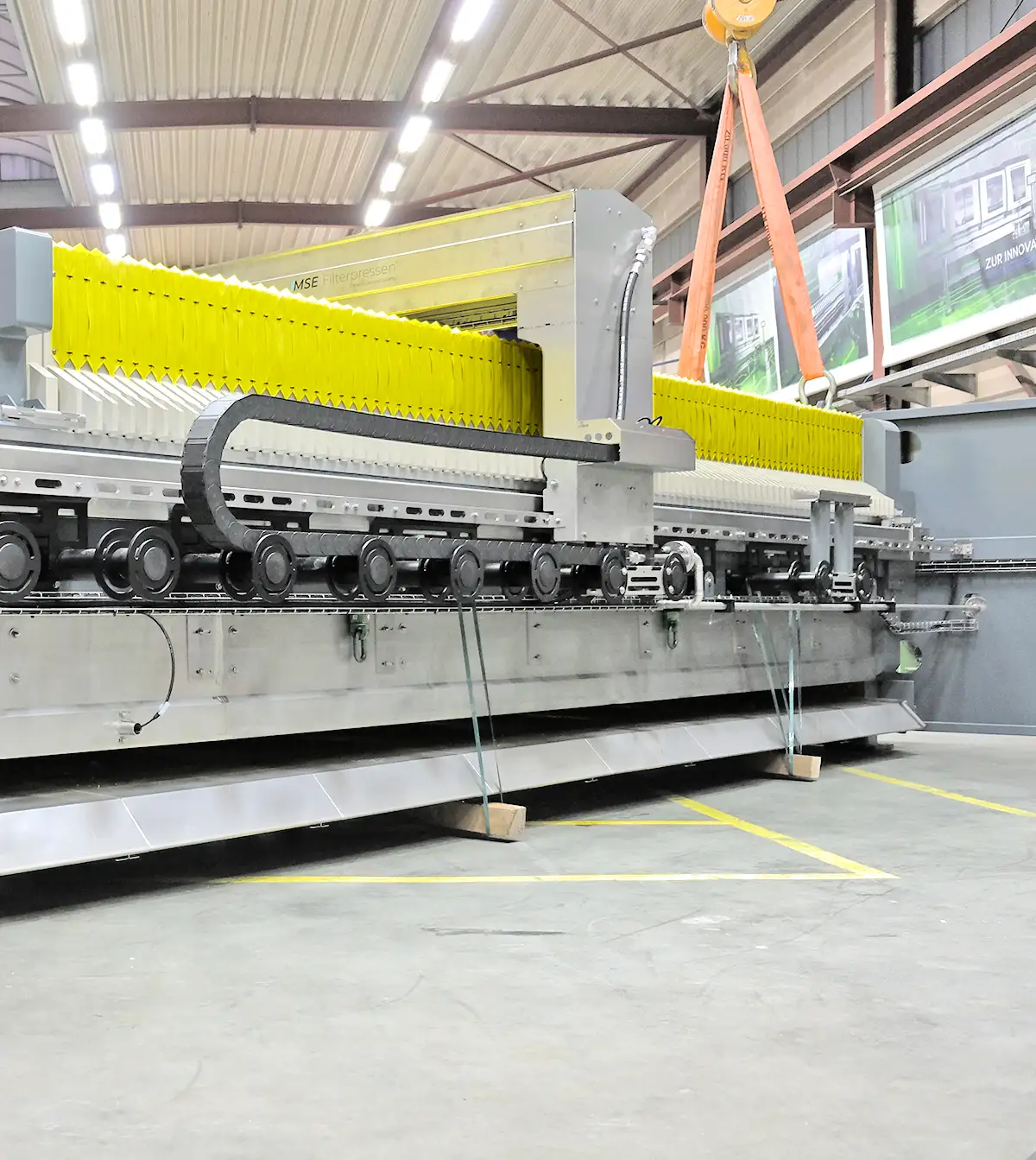
For demanding processes
Filtration with Advanced Process Engineering Expertise
During catalyst production, filter presses process media such as oxidic carrier materials, fine precipitation products, metal-containing suspensions, and synthetic intermediates.
These applications require:
- preservation of material structure to maintain catalytic activity
- stable pH values and defined ion profiles
- reproducible washing procsses
- material selections suitable for chemically reactive media
- targeted thermal support, for example through hot-water membrane cycles
The combination of precise pressure control, temperature management, and material resistance makes filtration in catalyst production one of the most demanding process engineering applications.

Key design considerations
Safety and ATEX Compliance
Many catalytic production processes involve substances that may become explosive or flammable under specific operating conditions.
Consequently, ATEX requirements must be considered throughout the system design.
MSE filter presses can be fully integrated into safety-critical plant concepts and support features such as:
- application-specific drive concepts
- explosion-proof electrical components
- safe control architectures
- controlled surface temperatures
- carefully selected construction materials
The filter press therefore fulfills not only a process engineering function but also an essential safety function within regulated production environments.
Maximizing results
How Precise Filtration Improves Efficiency and Process Transparency
Reproducible filtration delivers measurable benefits across multiple areas:
- defined residual moisture shortens drying times
- stable filtrate supports reproducible washing processes
- product losses are minimized, particularly with metal-containing media
- homogeneous filter cake structures improve process reliability
- fewer unplanned interventions reduce operating costs
Together, these factors create the foundation for economical, resource-efficient, and consistently high-quality catalyst production.

Real-time process intelligence
Digital Process Support with AI:PureLogic
Using the AI:PureLogic control platform, the filter press becomes a data-driven component of the overall production process.
Parameters such as filling behavior, sludge consistency, filter cloth condition, and pressure profiles are continuously monitored.
Based on this information, pressing pressure, squeezing times, filter cloth cleaning, and filter cake discharge are automatically optimized.
This supports: stable cycle times, reduced downtime, transparent process data and controlled and reproducible plant operation.
Focus on reproducibility
Filter Press Technology as a Quality-Critical Process Step
Catalysts are manufactured through highly controlled production processes. Consequently, filtration solutions must combine chemical sensitivity, consistent process performance, and mechanical precision. MSE filter press technology fulfills these requirements and helps ensure reproducible material properties across numerous production batches.
Contact
Your Next Step
Whether processing catalytic intermediates, fine specialty chemical products, or sensitive chemical compound sludge, a detailed process analysis forms the basis for a technically reliable filtration concept.
Based on this analysis, MSE develops filtration solutions specifically engineered to meet the demanding requirements of catalyst production and fine chemical manufacturing.
Request Your Free Process Analysis Today

The MSE Techletter
Find out all about the latest technologies, developments and valuable know-how about filtration technology – with our Techletter!
Inquiry Form
Your Process Requirements at a Glance
The more we know about your process medium and the relevant process parameters, the more accurately we can assess your filtration application. Simply provide the available information and supporting documents. We will review your requirements and get back to you to discuss the next steps and the appropriate technical solution.