

Coal-fired power plants generate mineral sludge at several stages of the process—particularly during flue gas desulfurization (FGD gypsum), ash handling, and water treatment. These material streams are technically demanding: they are highly abrasive, subject to fluctuations in solids content, and exhibit changing rheological properties due to varying operating loads and plant conditions.
At the same time, dewatering plays a vital role in maintaining stable internal water circuits, reducing recirculation volumes, and controlling disposal quantities. Reproducible residual moisture and consistent filtrate quality are essential—even under changing operating conditions. Increasingly stringent water regulations, higher plant availability requirements, and economic pressures place additional demands on filtration technology.
The key requirement is therefore a filtration solution that reflects real plant operation: mechanically robust, precisely controllable, and capable of delivering stable long-term performance.
Demanding operating conditions
Practical Requirements of Mineral Power Plant Sludge
Sludge generated during flue gas desulfurization, ash transport, and water treatment combines several critical characteristics. The mineral matrix—consisting of gypsum, fly ash, lime, metal hydroxides, and silicates—responds sensitively to changes in pressure, throughput, and viscosity. Even slight variations in fuel quality or operating load directly influence filtration performance.
FGD wastewater treatment (FGD-WWTP) sludge is particularly demanding, often containing elevated chloride and sulfate concentrations together with dissolved metals. These conditions require: corrosion-resistant materials, mechanically durable components and controlled pressure profiles that prevent uncontrolled increases in filtration resistance.
Ash and coal sludge present additional challenges. Fine, hard particles continuously wear filter plates, seals, and filter cloths. At the same time, solids concentrations can vary significantly, affecting cycle times and dewatering performance.
Stable operating windows and reproducible process control are therefore essential for long-term operation.
What makes the difference
Evaluating Existing Dewatering Technologies
Many power plants continue to rely on belt filter presses or centrifuges. While both technologies offer specific advantages, they often reach their technical limits under the fluctuating operating conditions typical of coal-fired power plants.
Belt filter presses generally require relatively low capital investment but often consume large quantities of flocculants, do not always produce homogeneous filter cake, and require increased operator attention and cleaning effort. Abrasive or highly variable sludge further accelerates wear and increases maintenance requirements.
Centrifuges achieve low residual moisture and high throughput with homogeneous media such as certain gypsum products. However, they require considerable energy and react sensitively to fluctuations in composition and solids content when processing mixed sludge, which can reduce overall process stability.
The demands of modern power plant operation—including predictable disposal routes, reproducible filtrate quality, and stable 24/7 performance—are best met by dewatering technologies that combine high performance with precise and robust process control.
An integrated system approach
Stable Filtration Under Real Operating Conditions
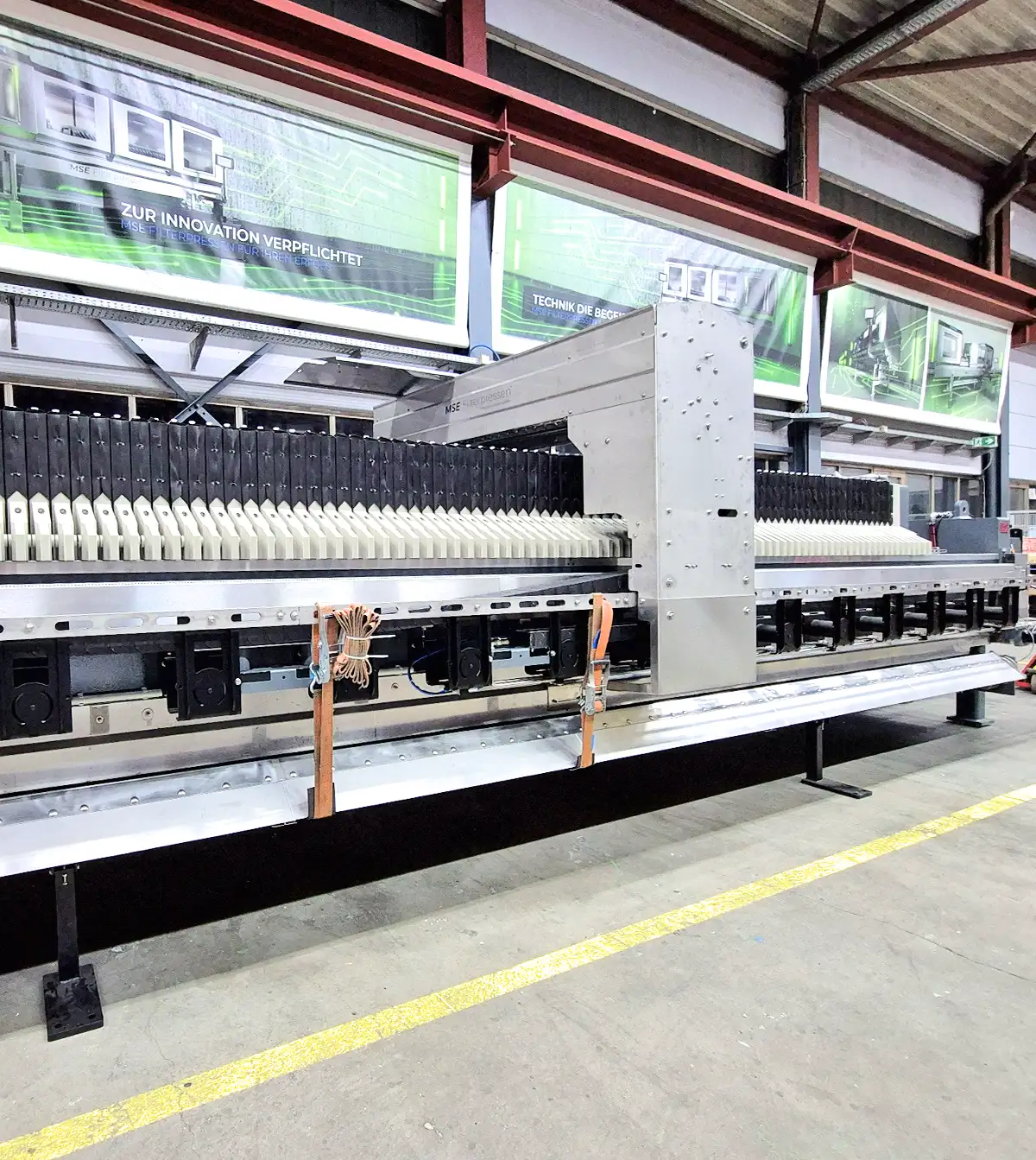
A filter press can only meet these demanding requirements consistently if it is specifically designed for the characteristics of mineral power plant sludge.
Long-term performance depends not on a single design feature but on the interaction of several key engineering principles:
- robust mechanical construction for continuously abrasive solids
- corrosion-resistant materials in product-contact areas, including high-alloy stainless steels or duplex materials for critical FGD applications
- controlled pressure profiles to prevent premature blockage while maintaining stable throughput
- a coordinated filtration strategy that remains reproducible even during fluctuating operating conditions
Within MSE filter presses, carefully engineered filter plates, application-specific filter cloths, and reliable hydraulic systems form an integrated solution that provides uniform compaction even for heterogeneous mixed sludge.
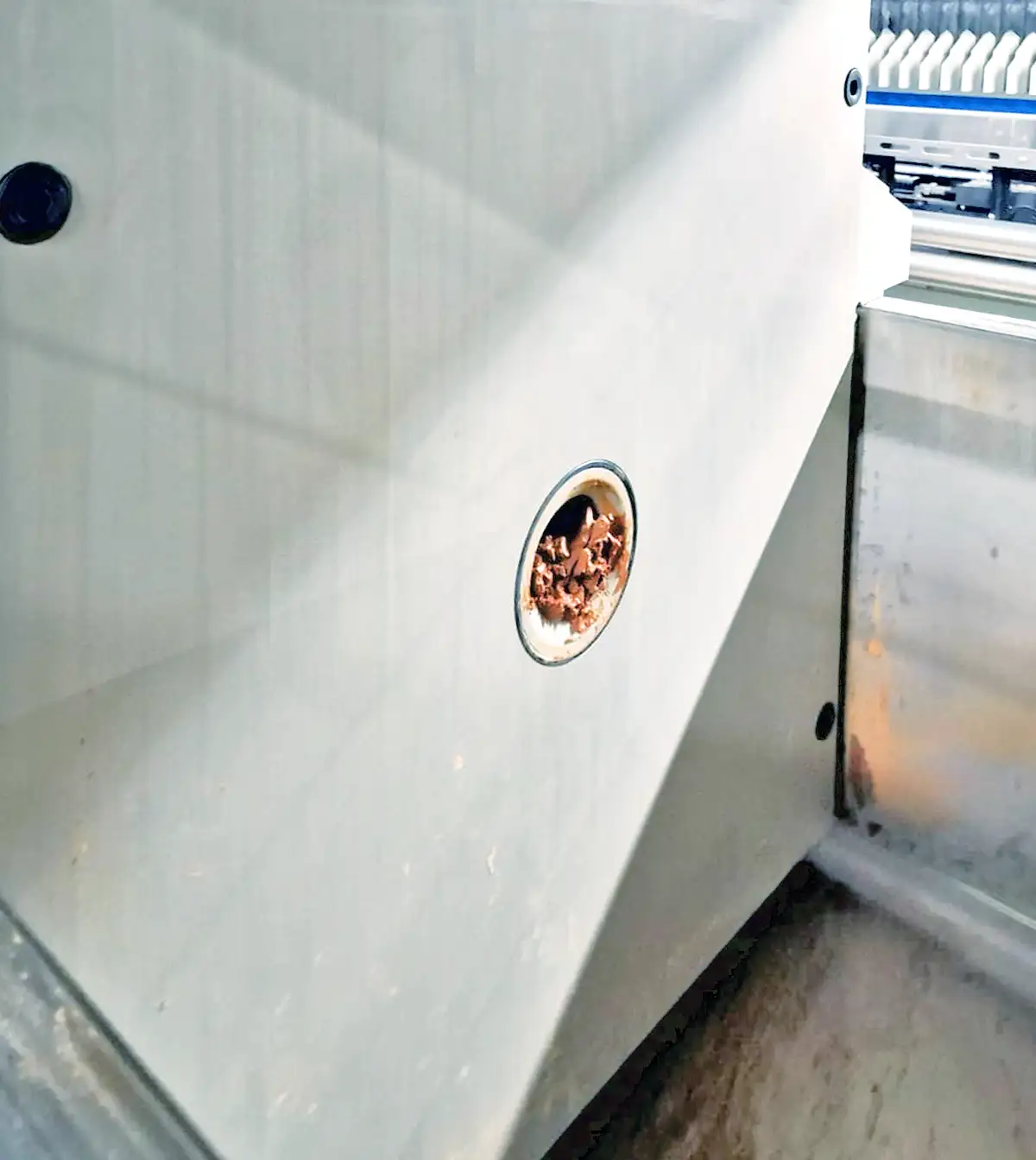
The resulting residual moisture, filter cake structure, and discharge characteristics remain predictable and consistent.
For plant operators, this means improved operational reliability, fewer unplanned interventions, and filtrate streams that can either be safely discharged or returned to the process, depending on the overall plant concept.
Consistent reproducibility
Reliable Results Despite Changing Sludge Characteristics
The properties of ash, gypsum, and water treatment residues are closely linked to power plant operating conditions. Changes in fuel quality, load profiles, water chemistry, or flue gas desulfurization directly influence particle size distribution, solids content, and filtration behavior.
Effective filtration treats this variability as normal operating practice rather than an exception.
Pressure profiles, filling sequences, and washing cycles are therefore controlled to ensure that throughput and filtratequality remain reproducible despite fluctuating feed conditions.
The intelligent AI:PureLogic control system further enhances process stability by providing adaptive process control. Variations in sludge characteristics are detected at an early stage and automatically compensated, ensuring uniform cycle times and consistent filter cake structures.

Automation for predictable operation
Reliable Dewatering in Continuous Service
Coal-fired power plants operate either under base-load or flexible operating conditions while sludge streams are generated almost continuously.
Accordingly, dewatering systems must operate reliably over extended periods with minimal operator intervention.
Proven solutions provide:
- largely autonomous operation
- uniform and easy-to-handle filter cake
- reproducible filtrate quality
- mechanical designs engineered for high cycle frequencies and continuous operation
Automated functions such as controlled filter cake discharge and reliable filter cloth cleaning operate together as an integrated system that can be seamlessly incorporated into existing plant operations.
As a result, dewatering becomes a stable and predictable component of daily plant operation rather than a limiting process step.
Coordinated process interaction
The Economic Benefits of Precise Filtration
During continuous operation, measurable process improvements are what matter most.
Lower residual moisture reduces disposal volumes, simplifies transportation and logistics, and directly lowers operating costs.
At the same time, clean filtrate reduces the load on downstream water treatment systems or can be safely returned to the process.
These benefits are achieved through the combination of appropriate material selection, robust mechanical engineering, and a process strategy specifically designed for the respective material stream.
Only this integrated approach enables stable operating costs and predictable water management over long operating periods.
Contact
Your Next Step
Operating conditions vary from plant to plant depending on fuel type, water chemistry, flue gas treatment, and process flow rates.
MSE’s engineering team performs detailed process analyses to develop plant-specific dewatering concepts.
Based on this analysis, MSE designs dewatering solutions capable of reliably, safely, and consistently processing mineral power plant sludge over the long term.
Request Your Free Process Analysis Today

The MSE Techletter
Find out all about the latest technologies, developments and valuable know-how about filtration technology – with our Techletter!
Contact
Get in Touch Speak with Our Experts
How can we support you? We’re here for you throughout the entire
lifecycle of your filter press.